Showing posts with label David Bowie. Show all posts

David Bowie & Iggy Pop - Blah-Blah-Blah (1986)

Bowie's Silhouettes World Tour had ended in 1984, and he was left a wreck. It was his first large (mostly) drug-free outing in what felt like forever, and Bowie didn't have anything to keep him going. Bowie finished his Serious Moonlight album in mid 1984, and then he rested. Similarly to directly after the Beatles disbanded, he turned to films to keep him active. He had a starring role in Absolute Beginners and provided the title song that became a chart hit when it was released as a single. His only other major film outing during this time was Jim Henson's Labyrinth. Henson wanted him to star as Jareth in the film, but Bowie just didn't have it in him for another major film role. He did however work with Sting, formerly of the Police and the new actor for Jareth, in writing songs for the film that would come to be known as some of Sting's best solo work. For Bowie however, that was basically it when it came to big projects for the time being.

Until his dear friend Iggy Pop rang him up to help him on his new album. The two had met in 1971 and spent much time together in Berlin where each of them had a rebirth in their respective careers. Bowie accepted his offer, and he became the album's co-producer alongside David Richards. As the sessions went on, Bowie decided to pitch more and more of his own songs to Pop for use on the record (a few of these being songs that Bowie wrote for Labyrinth that went unused) until Pop had the bright idea to make it an official collaboration album between the two artists. Bowie reluctantly agreed, but it paid off in the end. The two were musically in sync, and their styles were nearly identical. The last thing that was added to the album before its completion was Paul McCartney's backing vocal on "Shades", marking another temporary Beatles reunion.

The album released on June 9, 1986 to mostly negative reviews, with critics saying it was "the most calculatedly commercial album of the two men's careers". The album's title, Blah-Blah-Blah, really fit the tone of the album, and Bowie and Pop knew it. Both of them would retrospectively disown the album, with Bowie calling it his "nadir".

This album would mark Bowie's final solo album of the decade. Following the Beatles' dissolution, he had grown massively not only as an artist but as an entertainer as well. But deep down, he missed playing with his old bandmates, and he was sure that they would share the same sentiment. It would later be shared with the public that Bowie booked several meetings with higher-ups from Apple Corps in late 1986, but for what purpose hasn't been shared publicly. Although sooner than later, it became obvious.

DAVID BOWIE & IGGY POP - BLAH-BLAH-BLAH
Released: 9 June 1986
Genre: Pop rock, big music, new wave, synthpop, dance-pop
Producer: David Bowie, David Richards

Side A
Real Wild Child (Wild One)
The Underground
Baby It Can't Fall
Shades [ft. Paul McCartney]
Dancing with the Big Boys

Side B
Magic Dance
Blah-Blah-Blah
Too Dizzy
Hideaway
Bang Bang

Back cover

David Bowie - Serious Moonlight (1984)

1982-83 was a rarely calm time for David Bowie. For once, there was no recording for the new studio album or playing live or anything of that sort. That's not to say he didn't work in other places. He had worked as the composer for the German film Christiane F. that released in late 1981 and later worked on films such as The Hunger and Merry Christmas, Mr. Lawrence, both releasing in 1983. But he would finally give in to his fans and start the Silhouettes World Tour that would span from early 1983-1984. His first solo tour, he would play both contemporary songs from his most recent album as well as old Beatles songs that he had performed on. All shows would include a performance of the Beatles' "Imagine" as a tribute to John Lennon. What was most noted by fans who went to these shows was Bowie's reworking of some his older songs, such as "Heroes" and "Changes", to fit a more modern dance-pop sound. This was the result of Bowie starting work on a new album in December 1982, something that fans didn't know just yet. Due to the tour, recordings was on and off, and, by the time of the tour's end, the album was still nowhere near finished.

Bowie had hired Chic guitarist Nile Rodgers to co-produce and help inspire a fresh, polished sound for his new record. In the last years of the 70's, Chic had become one of the most successful bands around, and Rodgers had written countless dance songs that would no doubt influence Bowie in the early 80's. Another overwhelming influence on the new album was the compact disc. Released only in 1982, a few artists such as Billy Joel had taken advantage of the new medium, releasing their newest albums as an alternative to the vinyl record. But Bowie wanted to take the idea further. Throughout 1983 and 1984 he recorded at least 15 tracks that he seriously considered for the album, a good amount of them over 5 minutes. Bowie's idea was to throw everything on there at once and commit to an hour album that would span only a single disc.

Both the LP and CD versions of Serious Moonlight would release on May 10, 1984. Critics and fans were immediately baffled when the album released, not only by the drasticly new sound Bowie had decided to pursue but also because of the CD release. Bowie knew that an hour long album on an entirely new way to store audio would be drastically expensive and almost certainly not worth it due to the album being recorded analog, resulting in less-than-desirable quality. But Bowie went through with it as an experiment for not only himself but also to see how the consumers would react. And they did not react well. The vinyl record almost tripled the sales of the CD release (ironically it would become Bowie's best-selling solo album of his entire career). This left the songs that weren't on the vinyl record somewhat rare until decades later when CDs became the primary medium for listening to music. The album was hailed as yet another left-turn for the musical chameleon that was David Bowie as well as for its collaborations with former Beatles Paul McCartney and Ringo Starr. Retrospectively, it has been seen as a precursor to the bloated CD albums that would come to define the 1990's.

DAVID BOWIE - SERIOUS MOONLIGHT
Released: 10 May 1984
Genre: New wave, pop rock, dance-pop, sophisti-pop, pop soul
Producer: David Bowie, Nile Rodgers

Disc One
Modern Love [ft. Paul & Linda McCartney]
China Girl
Loving the Alien
Let's Dance
Tumble and Twirl
Without You
Ricochet
Blue Jean
I Keep Forgettin' [ft. Ringo Starr]
Tonight [ft. Tina Turner]
This Is Not America [ft. Pat Metheny]
Criminal World
Shake It
Dancing in the Street [ft. Mick Jagger]

Side A
Modern Love [ft. Paul & Linda McCartney]
China Girl
Loving the Alien
Tonight [ft. Tina Turner]

Side B
Let's Dance
Blue Jean
Tumble and Twirl
Shake It

Back cover

David Bowie - Silhouettes and Shadows (1981)

David Bowie had gone through a lot of turbulence in the years leading up to 1981. He had rejoined his old band, the Beatles the previous year following a period of independence that had rewarded him musical freedom. The reunion, however, was short lived when John Lennon was shot dead that December. The band quickly issued their final statement in April 1981 and then dispersed. Bowie looked back at what had happened and contemplated his place in the ever-changing music world. Now that he had to continue on as a solo artist permanently, could he sustain his current popularity? Bowie had indulged himself in art rock for the good part of half a decade, and yet, it felt so different from the punk and new wave that had dominated airwaves for the last few years. Regardless of what genre he would frequent next, Bowie was keen on staying on top, even without a band.

Bowie began work on a new album almost immediately following the Beatles' dissolution. In retrospect, it was actually quite easy for Bowie to prepare a solo record of all new material within a few months given the material he already had just lying around. Almost everything that ended up on the album was somewhat old material; "Kingdom Come", "Teenage Wildlife" and "Because You're Young" were outtakes written for Look Back in Anger, "Neighbourhood Threat" and "Don't Look Down" were Iggy Pop songs covered as a thank you from Bowie for his work in Berlin, "Cat People" was written for the movie of the same name that would be released the following year, "The Drowned Girl" was a song taken from the Bertolt Brecht play Baal, which Bowie would star in a BBC production of, and "Under Pressure" was a collaboration with Queen that would release as a single in October. Only "It's No Game", the opening track, would be written for the album, and even that wasn't completely new. It was partially taken from a portion of "Return of the Thin White Duke" which had, in turn, been written as early as 1971. Bowie's screaming was meant to evoke John Lennon's performance on the first Plastic Ono Band Album, Fly, as a tribute to him.

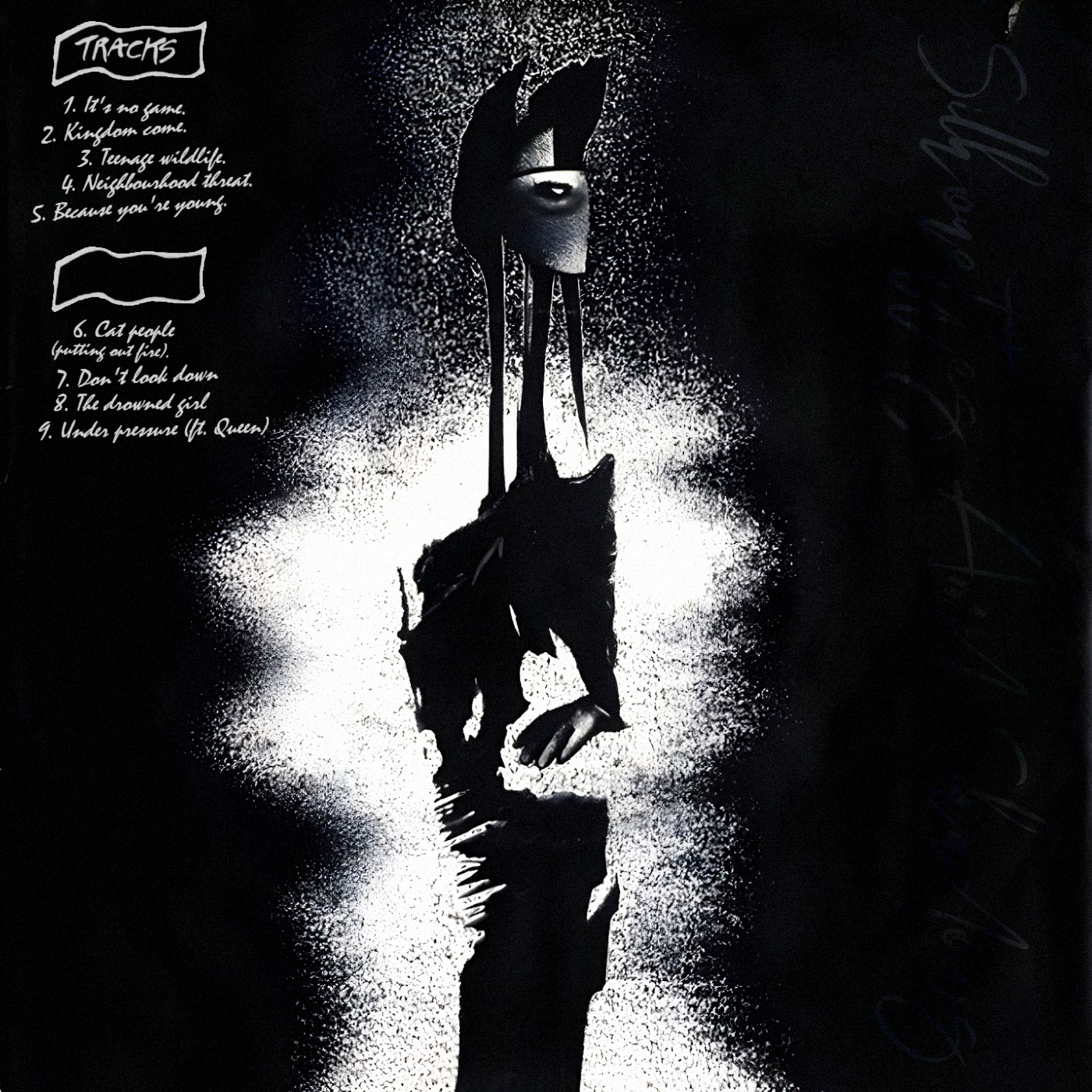
Silhouettes and Shadows, Bowie's first solo album following the dissolution of the Beatles, would be released on November 13, 1981 to moderately successful reviews. While critics noted that the songs didn't have as much staying power as Bowie's songs on Look Back in Anger did, they considered it a follow-up to the Beatles' final album due to the songs' shared similarities. They also noticed a sneaking influence of new wave and even modern dance music on the record, an interesting curiosity to all who noticed. Nonetheless, the 80's had officially arrived, and Bowie's future as a solo career seemed bright. Fans could only wait to see what he would do next.

DAVID BOWIE - SILHOUETTES AND SHADOWS
Released: 13 November 1981
Genre: New wave, pop rock, art rock, art pop
Producer: David Bowie, Tony Visconti

Side A
It's No Game
Kingdom Come
Teenage Wildlife
Neighbourhood Threat
Because You're Young

Side B
Cat People (Putting Out Fire)
Don't Look Down
The Drowned Girl
Under Pressure [w/ Queen]

Track list sources:

Tracks are sourced from Scary Monsters (and Super Creeps), Tonight and A New Career in a New Town (1977-1982).

Back cover

Rockestra - Rockestra (1979)

Paul McCartney just couldn't sit still for even a minute. He and everybody else knew it. He always had to be doing some sort of work. So when the Beatles temporarily broke up in February 1979, his mind started racing. He used the majority of the year to organize a series of benefit concerts called "Concerts for the People of Kampuchea". In the same vain as his bandmate George Harrison's "Concert for Bangla Desh" eight years prior, the money from the concerts would go to victims of war-torn Cambodia. Along with Kurt Waldheim, the Secretary-General of the United Nations, McCartney managed to get a series of well-known stars, both old and new, to perform. These included The Who, Queen, Elvis Costello and The Clash, all of which were still making hits. But it would the last star to become involved that would make headlines. Fresh out of Berlin and a short world tour, David Bowie had settled down in New York City. Drug-free and in his best years, he decided to check up on an old friend after reading the paper. McCartney was reluctant to have Bowie perform following his less than amicable leave from the Beatles three years prior. But, eventually, he would be allowed to perform a set of his own. Fans became excited and rumors spread that George Harrison and Ringo Starr had also agreed to perform, but alas, they were all just rumors.

McCartney would perform a set with his backing band Wings, former Beatles Linda McCartney and Denny Laine as well as two other new members. He would later call this performance awful and it would end up being one of the last concerts where McCartney would play with Wings. The concerts would prove to be a success in the end. At the end of the final concert, McCartney, Wings, Pete Townshend of the Who, Bowie, and many other musicians there that day would perform a small set as "Rockestra", billed as Earth's Biggest Band. This specific performance would also be received well, but it also made people curious as to what else the band would do, if anything. Originally a one time thing for the concert, Bowie persuaded McCartney to work with him again, citing an eagerness to work with synths. Townshend and John Bonham of Led Zeppelin would join them, and Townshend would later invite David Gilmour of Pink Floyd to make the greatest five-some any rock fan had ever seen.

Truth be told, other than McCartney and Bowie, it took time for the band to know each other's styles well. This combined with the fact that Gilmour brought no songs with him after the release of his first solo album meant that work had to be done on new (and sometimes old) material. Bowie brought forth "Sound and Vision" a song he had originally saved for his eventually return to the Beatles. Bowie thought it worked well alongside McCartney and Townshend's own experimental work. The lead single was obviously going to be Townshend's "Let My Love Open the Door", a song all of them knew would be an instant hit. Recording finished in November 1979, and the album, self-titled, was released on December 16, 1979. People immediately liked what they heard, and thought the album contained a good mix of all of their own styles. They also thought that the album was superior to the Beatles' Going Faster, not even a year old yet. But it had an unforeseen effect that no one else realized at the time. 

John Lennon, now 39 years young and almost four years into retirement, was sitting on his couch as he had many times before. His son, Sean, was upstairs and his wife, Yoko Ono, was out for the day. He had a guitar in hand and he was listening to his radio. All of a sudden, the DJ announced a new single called "Getting Closer" by a band called Rockestra, a name Lennon had never heard before. As the song started, Lennon dropped his guitar all at once. "Fuck a pig, that's Paul!" he said out loud. He had been out of the music scene for so long, this now months old album had completely evaded him somehow. He read a review of the album in the paper and saw the name "David Bowie" along with McCartney's. They were working together again and he hadn't even known it. For Lennon, this was the last straw. By now, he had a collection of songs he had written plus plenty of inspiration. He and Ono had been subjected to new wave music, something they were both interested in, and he was planning a trip to Bermuda with his family. There was inspiration abound! And now all this. And so, after some deep thought, Lennon picked up the phone and dialed a number he knew all too well. "This will be worth it", he said to himself. "It'll be just like starting over".

ROCKESTRA - ROCKESTRA
Released: 16 December 1979
Genre: Rock, hard rock, experimental rock, synth-pop
Producer: Paul McCartney, Chris Thomas

Side A
Rockestra Theme
Empty Glass
Getting Closer
No Way Out of Here
Old Siam, Sir

Side B
Sound and Vision
Let My Love Open the Door
Temporary Secretary
African Night Flight
I Like Nightmares
So Glad to See You Here
Boys Keep Swinging

Track list sources:

McCartney's tracks are all from Back to the Egg, with the exception of "Temporary Secretary", from McCartney II. All of Bowie's tracks are from Low and Lodger. Townshend's tracks are from Empty Glass with "I Like Nightmares" being a bonus track from The Who's Face Dances. Gilmour's one song is from his self-titled 1978 album.

Back cover

David Bowie - Despite Straight Lines (1978)

Things were looking up for David Bowie. His heavy drug addiction was in the past, the so-called "Bowie ban" by his label, RCA had concluded, and he was once again in the studio with his friend Brian Eno to record the follow-up to Day and Night. About half of the songs had already either been written or recorded by the time of the previous album's release, so he already had something to work with. They got to work in late March 1978, searching for new themes to go with. As the previous album was composed entirely of instrumental soundscapes, this album would contain relatively conventional songs with Bowie's voice present throughout most of it, although the instruments and sounds used in Day and Night would still be very prevalent here, plus even more.

As the sessions went on, Eno introduced something to Bowie that would completely change the course of recording: a deck of cards Eno produced himself called "Oblique Strategies". These cards were made to promote creativity for musicians in often unorthodox ways and encourage lateral thinking. Examples included having musicians swap instruments and introducing melodies of previously discarded songs. This turned Bowie's mind upside-down, and it allowed him to once again change his sound, even as the sessions were still ongoing. By the time recording for the now double album was finished, Bowie had retired the electronic and ambient style that he had used for the last year for art rock inspired by world and new wave. Bowie took advantage of this change in sound and sequenced the album so as to make the change gradual. The beginning would be the same electronic sounds used in Day and Night, but by the end, fans would be introduced to a new David Bowie.

The album released on September 29, 1978. Almost immediately, fans were much more keen to praise this album then his previous one. Critics saw it as a fitting chapter two, and today it is seen as a universal masterpiece. Over time, fans started calling Bowie's Day and Night, Iggy Pop's The Idiot and Bowie's Despite Straight Lines the Berlin Trilogy, as they were all recorded together in Berlin and all three have a somewhat similar sound.

DAVID BOWIE - DESPITE STRAIGHT LINES
Released: 29 September 1978
Genre: Art rock, experimental rock, electronic, ambient, avant-pop, world, new wave
Producer: David Bowie, Tony Visconti

Side A
Speed of Life
Beauty and the Beast
Joe the Lion
Breaking Glass
What in the World
Sons of the Silent Age

Side B
Fantastic Voyage
Always Crashing in the Same Car
Wild Is the Wind
Be My Wife
All Saints

Side C
DJ
Move On
Red Sails
Repetition
Blackout

Side D
Alabama Song (Whiskey Bar)
Yassassin (Turkish for: Long Live)
Red Money
Scream Like a Baby
The Secret Life of Arabia

Track list sources:

All tracks are sourced from Low"Heroes" and Lodger, with the exception of "All Saints" and "Fuji Moto San" ("Crystal Japan"), both sourced from the All Saints compilation.

Back cover

David Bowie - Night and Day (1977)

David Bowie had made the trip to Berlin in late 1976. Eager to make connections and draw inspiration from the burgeoning German culture, Bowie, and his good friends Iggy Pop and Brian Eno, took many trips around the city wanting to find out what Berlin got what America don't. They found their answer in krautrock, a broad genre of German experimental rock, careened by Tangerine Dream, Neu!, and Kraftwerk. Bowie had first heard the of the genre when the Beatles' own Station to Station was described as such. He knew it was the natural next step in his musical direction, and he decided to climb the next rung of his ladder of musical excellence.

Or at least that would've happened immediately if Bowie hadn't gotten caught up producing Iggy Pop's debut record, The Idiot. Similarly krautrock/art rock, the album was divisive, being a major sound change for the former Stooge. This put Bowie's label, RCA, into a panic of if Bowie's eventually next solo album would sound the same. RCA would physically block any releases made by Bowie during this time. On the bright side, this allowed Bowie to continue to gather influences. When he finally decided to start recording his own music, he once again got sidetracked by producing Iggy Pop's second album, Lust for Life, which would end up doing better than his debut. By the time RCA discontinued the boycott of Bowie's "experimental" music, it was now September, and they released his first post-Beatles album on October 14, 1977.

The one thing people noticed immediately was his singing, or a lack thereof. The album was composed entirely of electronic soundscapes, nothing that any Bowie or Beatles fan had heard before. On top of that, Bowie released no singles to promote the album, leaving it almost entirely drowned in mystery to the average buyer. It would later receive mostly positive reviews, with many diehard Bowie fans considering it a favorite.

DAVID BOWIE - NIGHT AND DAY
Released: 14 October 1977
Genre: Ambient, progressive electronic, art rock, space ambient, electronic
Producer: David Bowie, Tony Visconti

Side A
V-2 Schneider
A New Career in a New Town
Abjulmajid
Art Decade
The Weeping Wall

Side B
Sense of Doubt
Moss Garden
Neukoln
Subterraneans
But Some Are...

Track list sources:

All tracks are sourced from Low and "Heroes", with the exception of "Some Are" and "Abdulmajid" which are sourced from the 1991 reissues of the two albums respectively.

Back cover

The Pussy Cats - That's the Way It Is! (1976)

David Bowie had left the Beatles so he could find himself and, hopefully, quit his crippling drug habit that had been a part of him for the best part of 3 years. But this all didn't happen immediately. He was quite lazy, and took up temporary residence in Los Angeles, alongside the other former Beatle John Lennon. Kicked from his own band, Lennon was also starting to recover from his own drug and alcohol problems, although he was quite lazy as well. In the middle of it all was Harry Nilsson, a close friend of both Lennon and Bowie, a chart-topper in his own right. He never had a crippling drug addiction and his heavy drinking had subsided due to a ruptured vocal cord in 1974. During these times, the three hanged out often, usually ending the night at one of their favorite bars or restaurants. One night, Nilsson mentioned that the three of them should record an album together, although it was not a serious offer. The next morning, Bowie called the other two saying he had booked studio time for them, and right then, recording sessions began for their first album together.

For three junkies plunking away on any instrument they could get their hands on, recording sessions went surprisingly smooth, with them finding each other's vibes pretty quickly. In stark contrast to Station to Station, both Lennon and Bowie's most recently released material, the album had a soft rock/reggae feel to it, no doubt due to them not caring enough to attempt anything musically new. The album included four covers, including "That Is All", an unused song written by George Harrison that was given to Nilsson to sing. The band and album names were the last things given to the record. They called themselves the Pussy Cats, named after Nilsson's 1974 album of the same name (which Lennon produced). The album's name, That's the Way It Is!, came from Walter Cronkite's famous catchphrase, with Cronkite being a familiar face to all three of them.

The album released on July 9, 1976 to generally positive reviews. Critics appreciated the laid-back sound, and they hoped for another record from the three. Unfortunately, it was not to be, and this would be the only Pussy Cats album.

Soon after the album's release, Lennon finally reunited with Yoko Ono. She announced her pregnancy two months later, and Lennon decided to take an indefinite hiatus from music to focus on his family.

This left David Bowie alone. He still wasn't ready to rejoin his old band, and LA was already starting to look old to him. He started to retreat back into his worst habits until one night, he got a call. It was from his old friend Iggy Pop, and he said he wanted Bowie to meet up with him and Brian Eno. He agreed. Bowie was going to Berlin.

THE PUSSY CATS - THAT'S THE WAY IT IS!
Released: 9 July 1976
Genre: Pop rock, funk rock, art rock, adult contemporary
Producer: John Lennon, David Bowie

Side A
I'm Only Dancing (Again!)
Going Down on Love
Moonshine Bandit
Do You Want to Dance
TVC One Five

Side B
So Long Ago
Sail Away
Stay
That Is All
Since My Baby Left Me

Track list sources:

Bowie's songs are from Station to Station, with the exception of "I'm Only Dancing (Again!)" from Who Can I Be Now (1974-1976). Lennon's songs are from Walls and Bridges, with the exception of "Do You Want to Dance" from Rock 'n' Roll and "Since My Baby Left Me" from Menlove Ave.. Nilsson's songs are from ...That's the Way It Is. "So Long Ago" is "#9 Dream" from Walls and Bridges.

Back cover

David Bowie - Panic in Detroit (1973)

David Bowie's second solo album, Panic in Detroit released on October 19, 1973. It was the summation of a few ideas Bowie had floating around, both for the Beatles and for himself. He had a few songs from the Ziggy Stardust duology that had gone unused, a testament to his songwriting ability. Three of the songs, including the title track, were included on Side A, with "Time" and "Lady Grinning Soul" being written for the solo album. These five tracks, put together, made a mini rock opera that sets one final curtain for the Ziggy Stardust character. The B-side, on the contrary, was all covers, a remnant of another idea that Bowie had of making a British rock covers album that would encapsulate the songs of his youth. In the end, the only song not from a British band was "White Light/White Heat", a favorite for Bowie to perform live, by American group The Velvet Underground. Other covers were from The Who, The Rolling Stones, Pink Floyd, The Yardbirds and even his own band, The Beatles, with John Lennon himself lending a guitar part to "Across the Universe".

The album was received well, but was mostly seen as Beatles scraps, similar to Paul McCartney's solo debut. Most of the attention went to the album's hellish front cover, featuring Bowie holding a dog on it's hind legs surrounded by fire. A comparison to Satan Is Real by The Louvin Brothers, an album with one of the most infamous covers, was obvious, but the cover would end up being one of Bowie's best. This album also marked the end of Bowie's portrayal of Ziggy Stardust, although a picture of Bowie with supermodel Twiggy on the back cover had him wearing something similar to the Stardust outfit.

DAVID BOWIE - PANIC IN DETROIT
Released: 19 October 1973
Genre: Glam rock, art rock, hard rock, pop rock, blue-eyed soul
Producer: David Bowie, Ken Scott

Side A
Drive-In Saturday
Panic in Detroit
Time
The Jean Genie
Lady Grinning Soul

Side B
I Can't Explain
Let's Spend the Night Together
See Emily Play
White Light/White Heat
Shapes of Things
Across the Universe

Track list sources:

All songs on Side A are from Aladdin Sane. Songs on Side B are sourced from Pin Ups, Aladdin Sane, Bowie at the Beeb, and Young Americans.

Back cover

David Bowie - Don't Sit Down (1972)

In addition to John Lennon and Yoko Ono's output, David Bowie also had a large amount of songs that had gone unused from the Beatles last two albums. Bowie booked recording sessions following the release of Hunky Dory to record songs that had originally been recorded by the Beatles, along with a few new songs. The resulting album was Bowie's first solo album, Don't Sit Down, released March 3, 1972. The style of Side A matched The Man Who Sold the World, and Side B matched Hunky Dory. The result is a mesh of both sounds that only sounded natural for Bowie. The final song, "I'm Only Dancing" was written after fellow band member John Lennon disapproved of his choice of clothing for his live performances.

DAVID BOWIE - DON'T SIT DOWN
Released: 3 March 1972
Genre: Glam rock, folk rock, hard rock, art rock, pop rock
Producer: David Bowie, Ken Scott

Side A
She Shook Me Cold
Conversation Piece
Saviour Machine
Holy Holy
Unwashed and Somewhat Slightly Dazed
Don't Sit Down [hidden track]

Side B
It Ain't Easy
Fill Your Heart
Andy Warhol
Song for Bob Dylan
The Bewlay Brothers
I'm Only Dancing

Track list sources:

Songs are sourced from Space Oddity, The Man Who Sold the World, and Hunky Dory. "Holy Holy" and "I'm Only Dancing" are sourced from Five Years (1969-1973), and "It Ain't Easy" is from Ziggy Stardust.