Paul McCartney & Wings - Amiens Mons (1984)

Following the moderate success of Arnie Pupe, Paul McCartney wished to get back on the road and finally commit to a world tour. McCartney hadn't done a tour of that scale since the mid 1970's with the Beatles, but since then he had done multiple smaller venue tours with his backing group Wings. Wings had formed in 1972 and usually comprised of Paul, his wife Linda and friend Denny Laine, along with some other lesser known session musicians that changed over time. It was formed to give McCartney an excuse to play live shows when the other Beatles weren't up to it, and the band consistently broke up and reformed when McCartney felt the need to tour. Before 1983, their biggest concert had been at the Concert for the People of Kampuchea in 1979, in which their lineup was the two McCartneys and Laine, as well as Laurence Juber as an additional guitarist and Steve Holley as their drummer. This lineup returned for their 1983 tour that didn't end until mid 1984. This tour roughly coincided with David Bowie's world tour that also went from 1983-84. Some expected a reunion of some kind, but in the end none ever occurred.

The tour would end up being incredibly well received, and McCartney wanted to take the energy of their live shows into the studio. Sessions for a new McCartney album, and his first with Wings, would start while the tour was still underway. George Martin would return as the album's producer, despite some pushback for McCartney to record the album on his own. He eventually fell in line, and for once, McCartney didn't have to assemble a band to record his album with. Recording went smoothly and, for the most part, the live energy that McCartney wanted was maintained. The album eventually became a double as a concept was established; the first disc would symbolize war and conflict, and the second would represent peace through love. This would be represented in the album's name Amiens Mons, referring to the first and final cities of the Hundred Days Offensive that would end World War I. Holley would be accompanied by Ringo Starr on a few tracks, and George Harrison would add guitar to "Cage" and "Through Our Love", although David Bowie, still on his world tour, wouldn't be able to add anything.

Amiens Mons would release on February 27, 1984 to very positive reviews. Critics would applaud the exceptional songwriting effort, typical from Paul McCartney, as well as the rest of Wings, who provided the backbone for McCartney's musical ideas. Laine and Linda McCartney's songs weren't ignored either, both given credit for their musical and lyrical abilities. The album would go on to be a favorite of Generation X, and it along with Bowie's Serious Moonlight would come the closest to hitting the mainstream. Retrospectively, the album has been considered the best thing McCartney associated himself with in the 80's, minus Look Back in Anger of course. David Bowie as well as for its collaborations with former Beatles Paul McCartney and Ringo Starr. Retrospectively, it has been seen as a precursor to the bloated CD albums that would come to define the 1990's.

PAUL MCCARTNEY & WINGS - AMIENS MONS
Released: 27 February 1984
Genre: Pop rock, art pop, progressive pop
Producer: George Martin

Side A
Tug of War
Be Together
The Other Me
Clock on the Wall
The Pound Is Sinking
So Bad

Side B
Again and Again and Again
Ballroom Dancing
Rainclouds
Be What You See/Love Awake
Maisie
Cage

Side C
Pipes of Peace
Silly Love Songs
Silver
Dress Me Up as a Robber
Hey Hey

Side D
Weep for Love
Through Our Love
Love's Full Glory
Summer's Day Song
Tug of Peace
One of These Days

Back cover


Ringo Starr - It Beats Sleep! (1983)

See Old Blood for details.

RINGO STARR - IT BEATS SLEEP!
Released: 16 June 1983
Genre: Pop rock, new wave
Producer: Ringo Starr, Joe Walsh, Paul McCartney, George Harrison, Stephen Stills, Ronnie Wood

Side A
Private Property
In My Car
Hopeless
Wake Up
Attention

Side B
Picture Show Life
You Belong to Me
You've Got a Nice Way
Everybody's in a Hurry But Me
Going Down

Back cover

David Bowie - Serious Moonlight (1984)

1982-83 was a rarely calm time for David Bowie. For once, there was no recording for the new studio album or playing live or anything of that sort. That's not to say he didn't work in other places. He had worked as the composer for the German film Christiane F. that released in late 1981 and later worked on films such as The Hunger and Merry Christmas, Mr. Lawrence, both releasing in 1983. But he would finally give in to his fans and start the Silhouettes World Tour that would span from early 1983-1984. His first solo tour, he would play both contemporary songs from his most recent album as well as old Beatles songs that he had performed on. All shows would include a performance of the Beatles' "Imagine" as a tribute to John Lennon. What was most noted by fans who went to these shows was Bowie's reworking of some his older songs, such as "Heroes" and "Changes", to fit a more modern dance-pop sound. This was the result of Bowie starting work on a new album in December 1982, something that fans didn't know just yet. Due to the tour, recordings was on and off, and, by the time of the tour's end, the album was still nowhere near finished.

Bowie had hired Chic guitarist Nile Rodgers to co-produce and help inspire a fresh, polished sound for his new record. In the last years of the 70's, Chic had become one of the most successful bands around, and Rodgers had written countless dance songs that would no doubt influence Bowie in the early 80's. Another overwhelming influence on the new album was the compact disc. Released only in 1982, a few artists such as Billy Joel had taken advantage of the new medium, releasing their newest albums as an alternative to the vinyl record. But Bowie wanted to take the idea further. Throughout 1983 and 1984 he recorded at least 15 tracks that he seriously considered for the album, a good amount of them over 5 minutes. Bowie's idea was to throw everything on there at once and commit to an hour album that would span only a single disc.

Both the LP and CD versions of Serious Moonlight would release on May 10, 1984. Critics and fans were immediately baffled when the album released, not only by the drasticly new sound Bowie had decided to pursue but also because of the CD release. Bowie knew that an hour long album on an entirely new way to store audio would be drastically expensive and almost certainly not worth it due to the album being recorded analog, resulting in less-than-desirable quality. But Bowie went through with it as an experiment for not only himself but also to see how the consumers would react. And they did not react well. The vinyl record almost tripled the sales of the CD release (ironically it would become Bowie's best-selling solo album of his entire career). This left the songs that weren't on the vinyl record somewhat rare until decades later when CDs became the primary medium for listening to music. The album was hailed as yet another left-turn for the musical chameleon that was David Bowie as well as for its collaborations with former Beatles Paul McCartney and Ringo Starr. Retrospectively, it has been seen as a precursor to the bloated CD albums that would come to define the 1990's.

DAVID BOWIE - SERIOUS MOONLIGHT
Released: 10 May 1984
Genre: New wave, pop rock, dance-pop, sophisti-pop, pop soul
Producer: David Bowie, Nile Rodgers

Disc One
Modern Love [ft. Paul & Linda McCartney]
China Girl
Loving the Alien
Let's Dance
Tumble and Twirl
Without You
Ricochet
Blue Jean
I Keep Forgettin' [ft. Ringo Starr]
Tonight [ft. Tina Turner]
This Is Not America [ft. Pat Metheny]
Criminal World
Shake It
Dancing in the Street [ft. Mick Jagger]

Side A
Modern Love [ft. Paul & Linda McCartney]
China Girl
Loving the Alien
Tonight [ft. Tina Turner]

Side B
Let's Dance
Blue Jean
Tumble and Twirl
Shake It

Back cover

Paul McCartney - Arnie Pupe (1982)

The death of bandmate and close friend John Lennon and the following dissolution of the Beatles hit Paul McCartney hard. By then, he had become the de facto leader of the group, always having the most of his songs on their records and guiding the group through the turbulent 70's. The fact that he had to give that all up hit him like a brick. He quickly became depressed, secluding himself inside his Scotland home with his wife and kids. But he would never stop making music. Indirectly influenced by the growing new wave and synth-pop artists that were becoming popular, McCartney began to play with synthesizers, hoping to make a new album out of his experiments. He had experimented with the same idea during the creation of Rockestra, but now McCartney wanted an entire cohesive product using the new technology. Unfortunately, this project would never come to be, or at least the majority of it. Always moving and always changing, McCartney would soon turn tail to a different more ambitious idea of his; a full-blown concept album.

The origins of Arnie Pupe go back to the Look Back in Anger sessions, even when John Lennon was still alive. In fact, McCartney stated in later interviews that had Lennon not died and the Beatles never broken up, the Arnie Pupe concept would've probably become their next project. Not letting his idea he thought genius go to waste, he got to work on a brand new batch of songs that he hoped would be cohesive enough to sequence into a story. He brought in his wife Linda on keyboards and his former Wings and Beatles bandmate Denny Laine on guitars (with a smattering of other session musicians) to help with his ambition, and brought back Beatles producer George Martin to produce. But as the sessions progressed, it became clear how flimsy McCartney's story was. The story revolved around a loner named Arnie who considered himself the world's most average person. The idea was that, throughout the album, he would find a sense of adventure and eventually love. But the songs didn't always reflect that lyrically. But the songs were damn good, so no one was bothered too much. The tracklist was tweaked multiple times until all parties were content with the tracks and its sequencing. George Martin convinced McCartney to add "Coming Up" to the tracklist, even though it didn't really fit the concept, because he thought it could be a hit.

While McCartney was the first Beatle to begin recording an album after the Beatles' dissolution, he was the second to release one, after David Bowie's Silhouettes and Shadows, with Arnie Pupe releasing on March 29, 1982 to mixed to positive reviews from critics. Critics pointed out that the "concept" was barely a concept with the story feeling jumbled throughout. But they praised the album's songwriting and production calling it a jumpstart for McCartney's solo career.

PAUL MCCARTNEY - ARNIE PUPE
Released: 29 March 1982
Genre: Pop rock, art pop, soft rock, progressive pop
Producer: George Martin

Side A
Introduction
Keep Under Cover
It's Not On
The Sweetest Little Show
The Average Person
Famous Groupies
Ebony and Ivory

Side B
Coming Up
My Secret Friend
Somebody Who Cares
After the Ball/Million Miles
Baby's Request

Track list sources:

Tracks are sourced from Pipes of Peace, Tug of War, London Town and Back to the Egg. "Introduction" is "A Beginning" sourced from the Beatles' Anthology 3, "Ebony and Ivory" is the solo version found on the Archive Collection of Tug of War and "My Secret Friend" is the single edit found on The 7" Singles.

Back cover

George Harrison - Lost/Found (1980)

The Beatles' Going Faster had bombed terribly for a Beatles record, and the fallout would happen publicly. Where the band were once celebrated for their mere appearance out in public, they were now barely noticed at all. The music world had changed, and by 1979 had given way to new wave, punk and other new forms of rock. The Beatles had tried to capitalize on these trends and failed. They would go on hiatus for the remainder of the year before even thinking about putting out a follow-up. But George Harrison didn't seem to mind all that much. It just gave him more free time for himself. He had initially left the band for some much-needed peace of mind (among other factors), and he thought to himself that this would be no different. He spent the remainder of 1979 mostly away from his guitar and with friends and family. He attended Eric Clapton's wedding to his former wife Pattie Boyd (Paul McCartney and Ringo Starr would also attend). He was able to dive deeper into his interest in motor racing, attending multiple shows during the year (Beatles song "Faster" was about said interest). He vacationed in Maui, a beautiful locale that allowed him to get away from it all for even a week or so. All of these events would form the basis of Harrison's next studio album, which began recording in late 1979.

The vibe was immediately different from the Beatles records as of late and even his previous solo efforts. Everyone was in a generally fun mood, and the songs generated from these sessions showcased it. George dug back to the early 70's (late 60's in the case of "See Yourself") to find suitable material for the record, along with newly-written material and a single cover. When finished, the record showcased a side of George that few had seen before; laid-back, happy and weirdly secular. The album was so slow-moving at times that Apple Records told Harrison to remove the slower-sounding songs in favor of some more upbeat songs. However, Apple Records President Ron Kass vetoed this decision, telling his staff they were out of their minds to deny a Beatle his music. Lost/Found would release on April 5, 1980 to mostly positive reviews. In actuality, many critics simply didn't review it. The bad press towards the Beatles had only begun to settle down, and Harrison was unfortunately just caught in the crossfire. This would start to effect his view of the press and the music industry for years to come.

GEORGE HARRISON - LOST/FOUND
Released: 5 April 1980
Genre: Soft rock, pop rock
Producer: George Harrison

Side A
This Song
Sat Singing
Beautiful Girl
Tears of the World
Learning How to Love You

Side B
Hong Kong Blues
See Yourself
Soft Touch
Your Love Is Forever
Save the World

Track list sources:

Tracks are sourced from Thirty Three & 1/3, George Harrison and Somewhere in England. "Sat Singing" is sourced from the Songs by George Harrison EP and was originally to be on Somewhere in England.

Back cover

David Bowie - Silhouettes and Shadows (1981)

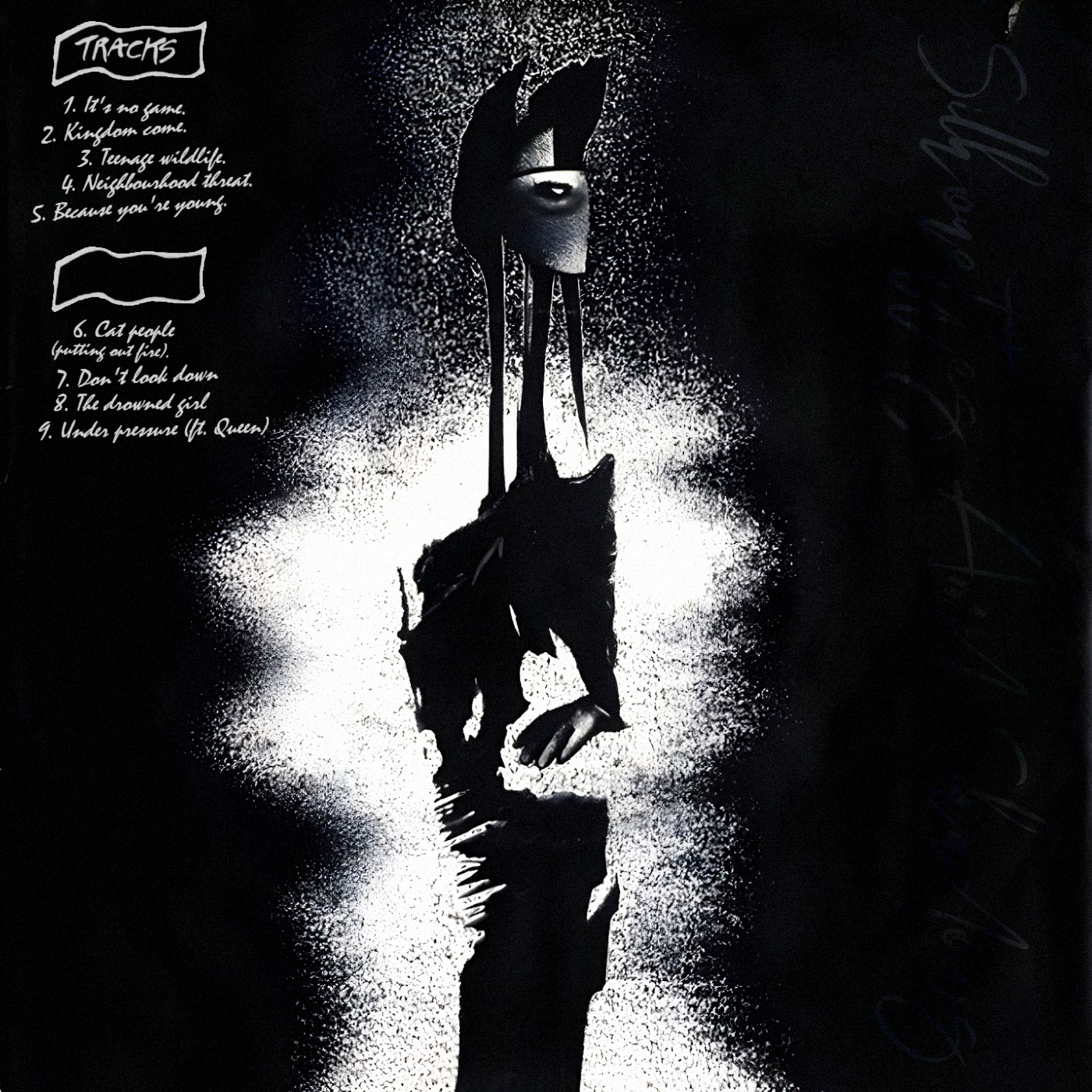
David Bowie had gone through a lot of turbulence in the years leading up to 1981. He had rejoined his old band, the Beatles the previous year following a period of independence that had rewarded him musical freedom. The reunion, however, was short lived when John Lennon was shot dead that December. The band quickly issued their final statement in April 1981 and then dispersed. Bowie looked back at what had happened and contemplated his place in the ever-changing music world. Now that he had to continue on as a solo artist permanently, could he sustain his current popularity? Bowie had indulged himself in art rock for the good part of half a decade, and yet, it felt so different from the punk and new wave that had dominated airwaves for the last few years. Regardless of what genre he would frequent next, Bowie was keen on staying on top, even without a band.

Bowie began work on a new album almost immediately following the Beatles' dissolution. In retrospect, it was actually quite easy for Bowie to prepare a solo record of all new material within a few months given the material he already had just lying around. Almost everything that ended up on the album was somewhat old material; "Kingdom Come", "Teenage Wildlife" and "Because You're Young" were outtakes written for Look Back in Anger, "Neighbourhood Threat" and "Don't Look Down" were Iggy Pop songs covered as a thank you from Bowie for his work in Berlin, "Cat People" was written for the movie of the same name that would be released the following year, "The Drowned Girl" was a song taken from the Bertolt Brecht play Baal, which Bowie would star in a BBC production of, and "Under Pressure" was a collaboration with Queen that would release as a single in October. Only "It's No Game", the opening track, would be written for the album, and even that wasn't completely new. It was partially taken from a portion of "Return of the Thin White Duke" which had, in turn, been written as early as 1971. Bowie's screaming was meant to evoke John Lennon's performance on the first Plastic Ono Band Album, Fly, as a tribute to him.

Silhouettes and Shadows, Bowie's first solo album following the dissolution of the Beatles, would be released on November 13, 1981 to moderately successful reviews. While critics noted that the songs didn't have as much staying power as Bowie's songs on Look Back in Anger did, they considered it a follow-up to the Beatles' final album due to the songs' shared similarities. They also noticed a sneaking influence of new wave and even modern dance music on the record, an interesting curiosity to all who noticed. Nonetheless, the 80's had officially arrived, and Bowie's future as a solo career seemed bright. Fans could only wait to see what he would do next.

DAVID BOWIE - SILHOUETTES AND SHADOWS
Released: 13 November 1981
Genre: New wave, pop rock, art rock, art pop
Producer: David Bowie, Tony Visconti

Side A
It's No Game
Kingdom Come
Teenage Wildlife
Neighbourhood Threat
Because You're Young

Side B
Cat People (Putting Out Fire)
Don't Look Down
The Drowned Girl
Under Pressure [w/ Queen]

Track list sources:

Tracks are sourced from Scary Monsters (and Super Creeps), Tonight and A New Career in a New Town (1977-1982).

Back cover

Paul McCartney - Days Past (1976)

Following the release of Station to Station and John Lennon and David Bowie's departure from the Beatles, Paul McCartney spent the majority of 1976 holed up in his home in Peasmarsh, East Sussex. He had become depressed from the state his now 15 year old band was in. He had his wife, Linda, and his kids, but most of all, he had music to keep him busy. And it was Linda who persuaded McCartney to record solo to keep himself busy from the stress that the Beatles had put on him. This would be his second solo record, following his self-titled album two years prior that sold fairly well. Surrounded by the soothing sounds and sights of nature in the quaint town he now resided in, he was persuaded to continue the soft rock sound he had achieved from his first record. Unlike his first album, there was very little variation in genre. He chose a sound, and he stuck to it. The album would release October 15, 1976 to, again, fairly popular reviews and sales. In fact, the album fared slightly worse than McCartney since it was just more of the same. There weren't any songs in particular that critics didn't like, but they found the album's style "inoffensive", as was the last one. To the critics, it confirmed one crucial fact, Paul McCartney needed the other members of his band to make masterpieces. McCartney himself was baffled by these reviews, and he wished to prove them wrong. And his idea of doing so was bringing his new soft/folk sound to the Beatles for their next album.

PAUL MCCARTNEY - DAYS PAST
Released: 15 October 1976
Genre: Soft rock, pop rock, piano rock
Producer: Paul McCartney

Side A
Let 'Em In
Love In Song
You Gave Me the Answer
Magneto and Titanium Man
Mrs. Vanderbilt
Treat Her Gently (Treat Her Kind)

Side B
She's My Baby
Must Do Something About It
Name and Address
San Ferry Anne
Lunch Box / Odd Sox
Warm and Beautiful

Track list sources:

Tracks are sourced from Wings at the Speed of Sound, Venus and Mars, Band on the Run, and London Town. "Must Do Something About It" is Paul's version from the Archive Collection of Wings at the Speed of Sound, and "Lunch Box / Odd Sox" is from the Archive Collection of Venus and Mars.

Back cover